Exploring the Potential and Challenges
In the dynamic world of cryptocurrency, Bitcoin continues to reign supreme, capturing the imagination of investors worldwide. Its meteoric rise over the past decade has been nothing short of spectacular, sparking debates and discussions about its potential to transform the financial landscape. As we venture further into this era of digital innovation, the question on everyone’s mind is: Can Bitcoin reach $300,000 by the end of 2024? While predicting the future of this enigmatic digital asset is no easy task, various factors suggest that such a milestone, though ambitious, is within the realm of possibility.
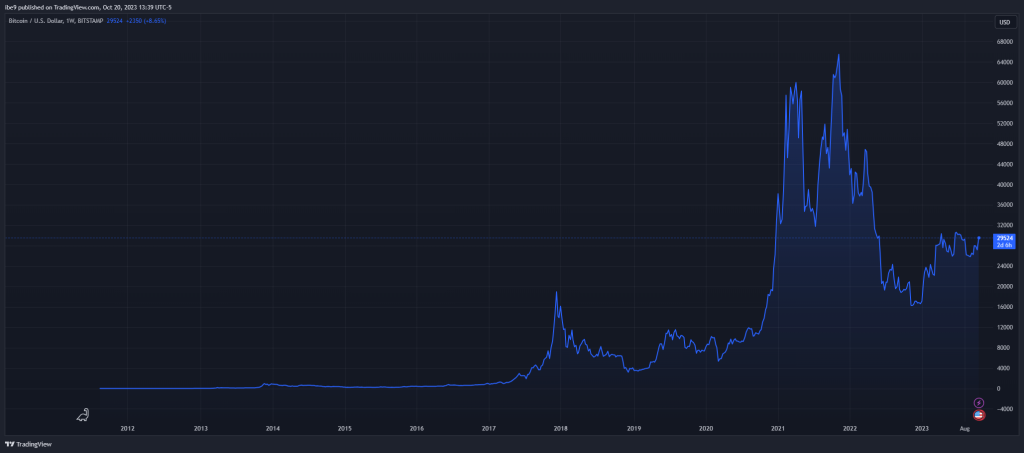
Today, 10/20/23, #BTC pump to $29,000
The Driving Forces Behind Bitcoin’s Growth
Technological Innovations
In the ever-evolving landscape of digital currencies, blockchain technology’s continuous refinement and enhancement stand as a testament to the relentless pursuit of security, efficiency, and scalability in this domain. Blockchain, the underlying technology of cryptocurrencies like Bitcoin, has undergone transformative advancements, each iteration aiming to address the intrinsic challenges and augment the innate strengths of the previous. One of the most notable advancements is the enhancement of security protocols. In the nascent stages of blockchain, concerns regarding security were rife. However, the integrity and security of transactions on the blockchain have been significantly bolstered through the integration of advanced cryptographic techniques, the implementation of multi-signature wallets, and the development of more robust consensus algorithms.
Transaction speed, another pivotal aspect, has been a focal enhancement point. While revolutionary, the original design of Bitcoin’s blockchain encountered scalability issues, leading to delayed transaction processing times, especially during periods of high demand. This challenge has been met head-on with innovative solutions aimed at increasing the number of transactions that can be processed per second. The integration of layer 2 solutions, such as the Lightning Network, exemplifies this evolution. The Lightning Network operates as a second layer atop the Bitcoin blockchain, facilitating instant transactions, reducing fees, and alleviating congestion on the main blockchain. It employs smart contract functionality to enable the creation of private channels between users. These channels ensure that transactions occur almost instantaneously, with the blockchain only involved in the opening and closing of the channels, thereby enhancing transaction throughput exponentially.
Moreover, the evolution of blockchain technology is characterized by the harmonious integration of these advancements. The enhanced security protocols ensure that, despite the increased speed and volume of transactions facilitated by solutions like the Lightning Network, the integrity and security of each transaction remain uncompromised. Cryptographic techniques, consensus algorithms, and other security protocols are continuously being refined to counter emerging threats and vulnerabilities. In essence, the trajectory of blockchain technology is marked by a balanced and synergistic integration of security, speed, and efficiency. Each advancement is meticulously crafted to address the inherent challenges and augment the strengths, ensuring that the technology remains resilient, robust, and responsive to the ever-changing demands and expectations of the digital economy. This intricate dance of evolution underscores the potential of blockchain technology to not only support the current valuation of cryptocurrencies like Bitcoin but to provide a sturdy foundation for unprecedented future valuations and applications.
Increasing Adoption
The acceptance of Bitcoin, both as an investment vehicle and as a medium of exchange, has been growing at an unprecedented rate. This surge in acceptance can be attributed to various factors, but the involvement of retail and institutional investors stands out as a significant driver. Let’s delve deeper into this phenomenon.
Retail Investors: The allure of Bitcoin for retail investors lies in its decentralized nature, the potential for high returns, and its emerging status as a hedge against traditional market volatility. With user-friendly cryptocurrency exchanges and wallet services becoming more prevalent, the barriers to entry for average individuals have been significantly lowered. This democratization of access has led to a surge in retail participation in the Bitcoin market.
Institutional Investors: Historically, institutional investors were hesitant about diving into the cryptocurrency space, primarily due to concerns about volatility, regulatory uncertainty, and security issues. However, the narrative has shifted in recent years. Recognizing Bitcoin’s potential as a store of value and its correlation benefits in portfolio diversification, hedge funds, asset managers, and even pension funds have started allocating a portion of their assets to Bitcoin. This institutional endorsement brings substantial capital into the market and adds a layer of legitimacy and trust to the cryptocurrency.
Major Companies and Bitcoin: Several multinational corporations have either invested in Bitcoin or integrated it into their operations. For instance:
- Tesla: Elon Musk’s electric car company made headlines by investing $1.5 billion in Bitcoin and briefly accepting it as a vehicle payment method.
- MicroStrategy: Under the leadership of CEO Michael Saylor, this business analytics firm has adopted Bitcoin as its primary treasury reserve asset, accumulating a significant amount over time.
- Square: Led by Twitter CEO Jack Dorsey, Square has invested in Bitcoin and integrated Bitcoin trading into its Cash App, making it accessible to its vast user base.
- Major Retailers: Companies like Overstock, Newegg, and even some branches of Starbucks have experimented with accepting Bitcoin as a payment method, signaling a shift toward mainstream commercial acceptance.
Impact of ETFs: Exchange-traded funds (ETFs) have played a pivotal role in bridging the traditional finance world with cryptocurrencies. Bitcoin ETFs, in particular, offer a way for investors to gain exposure to Bitcoin without owning the underlying asset. This structure provides several benefits:
- Liquidity: ETFs can be easily traded on traditional stock exchanges.
- Regulatory Oversight: Being listed on regulated exchanges, Bitcoin ETFs offer investors protection and transparency.
- Diversification: Institutional investors can integrate Bitcoin into their portfolios without the complexities of managing cryptographic keys or dealing with cryptocurrency exchanges. Retail and institutional investors’ growing acceptance of Bitcoin underscores a broader shift in perception. What was once viewed as a fringe asset or a speculative bubble is now being recognized for its potential value in the global financial ecosystem. As more companies invest in or accept Bitcoin and as financial instruments like ETFs make it more accessible, the trajectory for Bitcoin’s integration into mainstream finance looks promising.
- Favorable Regulatory Environment. The regulatory landscape for Bitcoin has seen a positive transformation, marking a significant stride towards its mainstream acceptance. Various governments and regulatory bodies globally are beginning to acknowledge the potential benefits of this digital asset, leading to more defined and supportive legal frameworks. El Salvador’s groundbreaking move to adopt Bitcoin as legal tender is a case in point, signaling a paradigm shift in how nations perceive and integrate digital currencies into their economic ecosystems. This Central American nation’s endorsement of Bitcoin has spurred discussions among other countries and highlighted the cryptocurrency’s potential to enhance financial inclusivity and economic growth. Furthermore, countries like Ukraine and Panama are exploring similar pathways, indicating a growing trend of national endorsements. Regulatory bodies in developed nations, including the U.S. and members of the European Union, are also working diligently to create balanced regulatory frameworks that safeguard investors while fostering innovation. These developments underscore a global shift towards the acceptance of Bitcoin, moving it from the peripheries of finance into a more central, recognized position. Each endorsement and positive regulatory development amplifies Bitcoin’s legitimacy, potentially paving the way for increased adoption, innovation, and integration into the global financial landscape.
Market Trends and Analysis
Historical Performance

Bitcoin’s price history is characterized by notable volatility, with significant price swings being common. However, a closer examination reveals an underlying trend of resilience and recovery. For instance, after reaching an all-time high of nearly $20,000 in December 2017, Bitcoin experienced a correction, dropping to around $3,000 in 2018. Despite this downturn, it exhibited a strong recovery, surpassing its previous all-time high and reaching over $60,000 in 2021.
Future Predictions
The future of Bitcoin, though speculative, is often painted in a positive light by numerous renowned analysts and financial experts. Their optimistic predictions are grounded in a combination of fundamental and technical analyses, focusing on intrinsic and extrinsic factors that could potentially drive Bitcoin’s price upwards. Some influencers on social media predict Bitcoin will reach $500,000 by 2025. It is just speculation because we have not reached that number before, and it will take a mass adoption to get there.
The Role of Speculation
PlanB’s Stock-to-Flow Model: One of the most cited predictions comes from an anonymous analyst known as PlanB. The Stock-to-Flow model, which has been historically accurate, predicts Bitcoin’s price based on its scarcity. According to this model’s latest iterations, Bitcoin could reach values exceeding $100,000 or even higher in the coming years.
Tim Draper’s Prediction: Venture capitalist Tim Draper, known for his early investments in tech giants like Tesla, Skype, and Twitter, has also been vocal about his bullish stance on Bitcoin. Draper predicts that Bitcoin could reach $250,000 by 2022-2023, citing increased adoption, especially in countries experiencing currency devaluation, as a driving factor.

Cathie Wood’s Outlook: The founder and CEO of ARK Invest, Cathie Wood, is another prominent figure with an optimistic view of Bitcoin. Wood suggests that if more corporations and institutional investors allocate even a small percentage of their portfolios to Bitcoin, its price could soar, potentially reaching the realm of $500,000.
The demand for Bitcoin is another pivotal factor. As more retail and institutional investors enter the space, and as Bitcoin’s utility as a store of value and medium of exchange increases, the demand is expected to rise. Analysts point to the growing interest from institutional investors, the integration of Bitcoin into financial products like ETFs, and increasing global adoption as catalysts for increased demand.
Inflation Hedge
Bitcoin’s intrinsic design, characterized by capped supply and decentralization, inherently offers a level of protection against the devaluing effects of inflation. While still relatively young and volatile, its performance trends during inflationary periods are promising. Retail and institutional investors are increasingly recognizing Bitcoin’s potential role in portfolio diversification, akin to traditional assets like gold. As Bitcoin matures and gains acceptance, its role as a viable inflation hedge is likely to become more pronounced, offering investors a digital alternative to traditional inflation-resistant assets. The ongoing developments in regulatory frameworks and technological infrastructure are expected to bolster Bitcoin’s position in this regard further.
In conclusion, while Bitcoin is not without its risks and challenges, its potential as an inflation hedge is becoming increasingly evident. Though ambitious, the prospect of Bitcoin reaching $300,000 by 2024 is not beyond the bounds of possibility as we gaze into the future. Investors looking to mitigate the impacts of inflation while exploring opportunities for significant returns are closely eyeing Bitcoin’s trajectory and evolving role in the global financial landscape.

Call to Action
As we navigate the intricate and dynamic world of Bitcoin and other cryptocurrencies, staying informed and conducting thorough research is not just beneficial—it’s essential. The landscape of digital assets is marked by its rapid evolution, presenting both unprecedented opportunities and inherent risks.
We encourage our readers to immerse themselves in continuous learning. Dive into the wealth of resources available, from expert analyses and forecasts to educational content that demystifies the complex world of blockchain and cryptocurrencies. Equip yourself with knowledge, which is your most valuable asset in this journey.
Consider the potential of diversifying your investment portfolio to include Bitcoin. As showcased, its resilience, growth trajectory, and emerging status as a potential hedge against inflation make it a worthy contender for portfolio diversification. However, remember the golden rule of investing—never invest more than you can afford to lose. Balance is key, and a well-diversified portfolio is your ally in navigating the volatile waves of the financial markets.
In the world of Bitcoin, informed decision-making is your compass. Stay updated, stay informed, and consider Bitcoin’s multifaceted potential. As we stand on the brink of a financial revolution, your informed choices today could pave the way for a future marked by financial growth and security. Embrace the journey with knowledge, caution, and strategic diversification. The future of finance is unfolding, and you have the opportunity to be part of this historic evolution.